

About Room Heat Pumps
What are Room Heat Pumps?
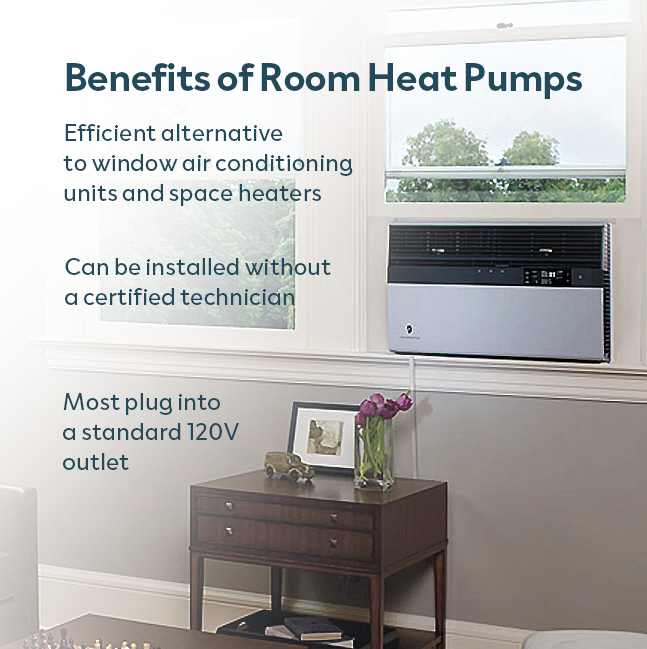
Room heat pumps are self-contained products, that provide efficient cooling and heating for small spaces, such as single rooms, modest apartments, or small homes. They achieve this using efficient heat pump technology and can be installed without a certified technician. Unlike central systems that require extensive ductwork or mini-splits that need ample space for outdoor compressors and refrigerant lines, room heat pumps install directly into existing window or through-wall openings and most plug into a regular 120V outlet, which can result in substantial cost savings compared to other cooling solutions.
The Collaborative’s definition of room heat pumps is broad. We use the CEE and ENERGY STAR specifications, federal appliance categories, and emerging market definitions and product standards to guide our categorization. The product also has a variety of names it can go by, including:
-
Room heat pumps
-
Window heat pumps
-
Micro heat pumps
-
Portable heat pumps
-
Room air conditioners with reverse cycle
Types of Room Heat Pumps
Dual duct portable heat pump

A freestanding unit that sits inside the living space and uses two ducts - one to bring in outdoor air and one to exhaust it - improving efficiency compared to single-duct designs. These units are easy to move and install, making them a flexible option for renters or spaces without permanent installation options.
Saddlebag window heat pump

A unit that straddles the window sill, with components both inside and outside the room. This design helps reduce indoor noise and improves efficiency while maintaining a relatively simple installation process.
U-shaped window heat pump

A window-mounted product with a U-shaped design that allows the window to close through the middle of the unit. This improves insulations, reduces noise, and enhances performance compared to traditional window units.
Traditional window heat pump

A more conventional design that fits within a window frame. These units are widely available and familiar.
Packaged terminal heat pump (PTHP)

A self-contained unit typically installed through an exterior wall. This includes products where the entire unit fits in a wall sleeve such as a Packed Terminal Air Conditioner (PTAC), as well as products with only air ducts that penetrate the building envelope.
Photos: GE, Gradient, Gree, Midea, Whynter